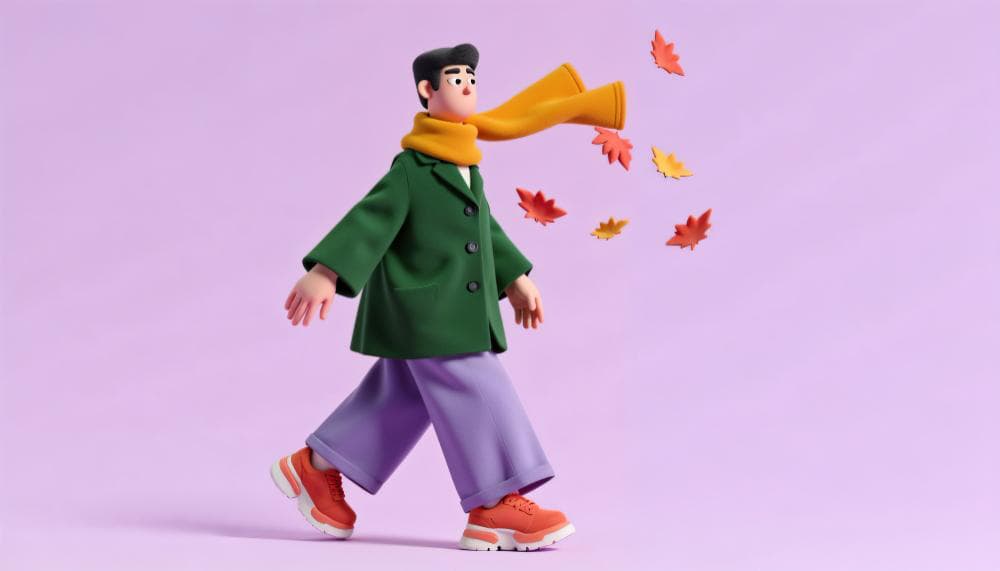
A convincing 3D character rarely begins with a perfect sketch. It usually starts with a rough idea, a collection of references, and a few unanswered questions about shape, movement, and personality. The useful skill is not producing detail immediately. It is protecting the central idea while the model passes through many technical stages and many opportunities to become generic.
I approach character work as a sequence of decisions rather than a contest to add polygons. Each stage should answer a different question. The blockout tests proportion. Sculpting defines structure. Retopology prepares movement. Materials explain surfaces. Lighting reveals whether all those choices still work when the character enters a scene.
Begin with a reference problem, not a reference pile
Decide what the viewer must understand first
Before opening modelling software, I write one sentence describing the character at a glance. It might be a careful mechanic carrying tools that are slightly too large, or an exhausted explorer whose equipment has been repaired many times. That sentence gives every later choice a purpose. It also prevents the reference board from becoming a random gallery of attractive images.
I divide references into anatomy, clothing, materials, props, colour, and mood. A separate section contains movement references: how a coat folds while walking, how a heavy bag pulls a shoulder down, or how a nervous person holds their hands. Static appearance and believable motion need different evidence.
Use photographs as evidence rather than templates
A photograph records one lens, one pose, and one moment. Copying it literally can import distortion into the model. I compare several angles and look for stable relationships: the width of the jaw relative to the cheekbones, the length of the forearm, or the way a boot changes the silhouette of the leg.
For fictional characters, reference remains important. A stylised face still needs an internal logic. If the eyes are enlarged, I decide how the lids close. If the hands are broad, I decide how they grip tools. Exaggeration becomes convincing when its consequences are carried through the whole design.
The production map
|
Stage |
Question to answer |
Useful stopping test |
|---|---|---|
|
Blockout |
Does the silhouette communicate? |
Readable in flat grey at thumbnail size |
|
Sculpt |
Do forms work from every angle? |
No detail needed to explain anatomy |
|
Retopology |
Can the model deform cleanly? |
Loops support planned expressions and poses |
|
Look development |
What are the surfaces made of? |
Materials remain clear under neutral light |
The stopping test matters because every stage can expand forever. A blockout does not need pores, and a sculpt does not need a final shader. When a stage answers its question, I save a clean version and move forward. That habit makes revision less frightening because I can return to a known checkpoint.
Block out the character as a moving silhouette
Large shapes carry more personality than tiny detail
I begin with simple volumes and a neutral material. The first review happens at a small screen size and from several distances. If the character only reads when I zoom into the face, the body design is not doing enough work. Shoulder angle, torso length, stance, hair mass, and props should already create a recognisable rhythm.
I also place a temporary camera early. Perspective changes proportion, and a model designed only in orthographic views can feel strange in the final shot. Testing a likely focal length helps me see whether the head, hands, and foreground props will dominate more than expected.
Check negative space
The spaces between arms and torso, between legs, and around props are part of the design. Clear negative space makes a pose readable. When every object touches the body, the silhouette becomes a single lump. I adjust the resting pose so accessories have room and the rig will not begin from an already-colliding position.
This is also the moment to test costume layers. A long coat, belt, and backpack may each work alone but compete when combined. I remove or resize elements before investing in detailed stitching. Subtraction at the blockout stage is much cheaper than rescuing a crowded final model.
Sculpt structure before surface
Primary and secondary forms set the truth
Primary forms establish the skull, rib cage, pelvis, and major limb masses. Secondary forms explain muscles, fat, folds, and bony landmarks. I move between close and distant views, but I spend more time distant than beginners often expect. A face with perfect pores still fails if the profile and planes are weak.
Asymmetry enters gradually. First I make the structural model work. Then I offset brows, soften one side of a smile, vary fabric tension, and add signs of use. Random noise is not personality. Asymmetry should suggest habit, age, gravity, or a specific event in the character’s life.
Clothing follows forces
Folds are easier to design when I identify compression, tension, and hanging points. A sleeve gathers at the elbow because the joint compresses it. A strap creates tension across the chest. Loose fabric hangs from support points. I avoid scattering folds evenly because real cloth responds to forces, not decoration.
I test an early pose before finalising cloth. A garment sculpted only for a neutral stance may collapse when the arm lifts. Even if simulation will be used later, the base design must provide enough material and sensible seams for movement.
Topology should serve performance
Plan loops around actions
Retopology begins with the animation brief. A speaking character needs careful loops around mouth and eyes. A helmeted background figure may need far less facial density. Knees, shoulders, and fingers receive geometry according to the range and importance of their motion. Even distribution is rarely efficient distribution.
I make deformation tests before UV work. A basic skeleton and a few extreme poses reveal pinching, volume loss, and collisions. Fixing loops now is faster than repairing textures after the topology changes. The test does not need polished weights; it only needs to expose the weak areas.
Materials tell a history
Start with broad physical differences
Before painting scratches, I establish whether a surface is cloth, skin, painted metal, bare metal, rubber, or glass. Roughness often separates these materials more effectively than colour. I review them under a plain studio light so dramatic lighting cannot hide unclear values.
Wear is placed where contact occurs: edges handled repeatedly, fabric beneath straps, soles, knees, and exposed corners. Dirt follows gravity and environment. A uniformly distressed object looks generated. A specific pattern of wear suggests use and makes a prop feel owned rather than downloaded.
Rig, pose, and expression bring the design back together
A neutral rig test is not a performance test
After technical deformation passes, I create one pose that expresses the original sentence. The mechanic should interact with the oversized tools. The explorer should carry weight unevenly. This pose reveals whether accessories, clothing, face, and proportions still tell the same story.
Facial expression tests begin with small changes. Real personality often appears in the timing and imbalance of a look rather than an extreme grimace. I test eye direction, lid tension, jaw position, and the relationship between brows and mouth. The expression must read from the final camera, not only in a facial close-up.
Finish by reviewing the idea, not just the render
Use three distances and one sentence
My final review happens at thumbnail, medium, and close range. Thumbnail checks silhouette and focal point. Medium range checks costume rhythm and pose. Close range checks surfaces and technical defects. If the model only succeeds at one distance, the hierarchy needs work.
I then read the original character sentence and ask what changed. Sometimes the final model is more interesting, and the sentence should be rewritten. Sometimes technical detail has buried the idea, and detail should be removed. A successful workflow does not preserve every early choice. It preserves a clear reason for the character to look and move the way they do.